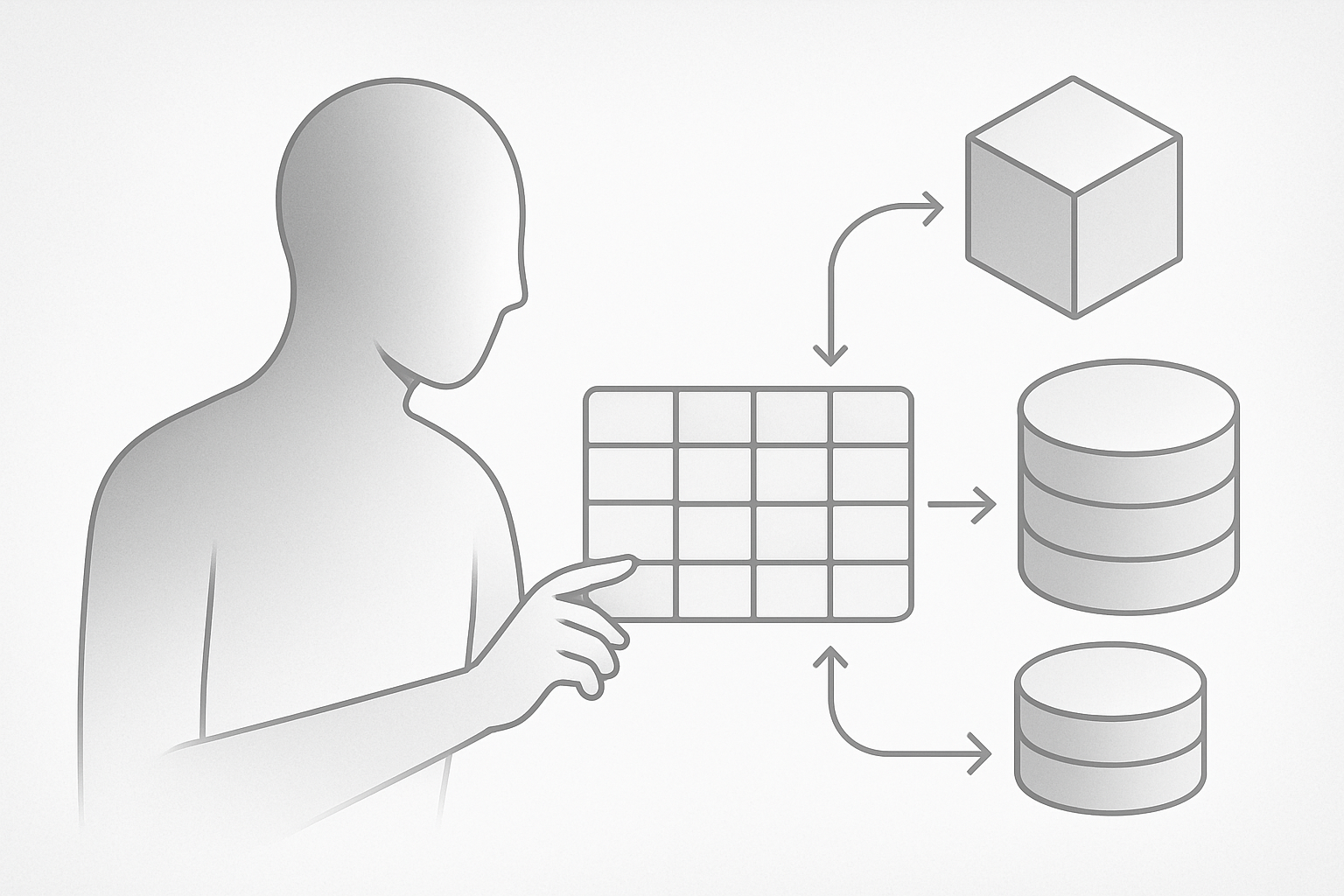
A faster, more reliable way to design complex models using an AI coding assistant and warehouse-integrated validation.
Data modeling can be a slow and tedious process. Teams interpret raw schemas, chase down logic across any existing dashboards and SQL files, write and refine transformations, test, debug, and repeat. It works, but most of the time is not spent on modeling. It is spent on mechanics.
Lately I have experimented with a workflow that keeps modeling judgment with the human, but uses an AI coding assistant to accelerate everything around it. The approach is not automated modeling. It is augmented modeling, where a tool like Claude Code handles repetitive or mechanical tasks so modelers can focus on design, semantics, and correctness. I believe this will be a game changer for how teams approach warehouse modeling in the near future.
A modern workflow for AI-assisted modeling
1. Start with raw schema exploration
Before gathering long lists of requirements, ask the coding assistant to analyze the raw data; essentially, data profiling. This will surface:
- nested fields
- naming inconsistencies
- grain mismatches
- derivable attributes
- redundant summary tables
- structural patterns that shape the model
Humans still decide what to do with these insights. The assistant simply accelerates discovery.
2. Generate a first-draft dimensional model using structural patterns
Based solely on source schemas, a coding assistant can propose:
- the atomic fact
- natural dimensions (device, page, geo, product, account)
- session or visit constructs using window functions
- surrogate key patterns
This gives a usable starting point quickly. The modeler then shapes it into something meaningful for the business.
3. Use the coding assistant to handle normalization and staging logic
Normalization is mechanical and repetitive. A coding assistant will accelerate the work:
- JSON parsing
- URL canonicalization
- case normalization
- dimension key hashing
- timestamp standardization
- deduplication patterns
This will free the modeler to focus on higher-order modeling decisions.
4. Reverse engineer business logic by scanning your existing ecosystem
Business logic is rarely documented in one place. A coding assistant can reverse engineer it by scanning across:
- dbt models
- SQL transformations
- BI logic
- notebooks
- legacy scripts
- even spreadsheets
This ensures the warehouse reflects the logic the business actually uses, not the logic people remember. It provides a solid starting point to further iterate.
5. Validate early using sample data
Build a limited slice of the model and let the assistant generate validation queries:
- row-count checks
- null and anomaly detection
- referential integrity
- grain alignment
- comparisons with existing reports
The assistant will not determine correctness, but it will accelerate how quickly you arrive at it.
6. Maintain documentation in parallel
Have the coding assistant update data model diagrams, or schema definitions every time SQL evolves. Something like dbml/dbdiagram that uses coding like syntax for diagram generation will work extremely well with a coding assistant.
Documentation will stay current by design, not by exception.
7. Collapse validation loops with MCP connectivity
This is where the biggest acceleration will come from.
Connecting your AI coding assistant directly to your warehouse through an MCP server fundamentally changes the modeling workflow.
With MCP connectivity, the assistant can:
- execute SQL instantly against Snowflake
- inspect facts and dimensions in real time
- validate assumptions immediately
- test fixes as you design them
- compare before-and-after outputs
- reduce multi-hour debugging cycles to minutes
This creates a tight, interactive loop. You stay in the modeling mindset while the assistant interacts with the live warehouse. There is no context switching, no waiting, no separate debugging phase. It does not change who designs the model. It changes how quickly and confidently the model can be validated, refined, and trusted. For many teams, this will end up being the single most impactful shift in their modeling workflow.
Core principles of AI-accelerated modeling
These principles emphasize the coding assistant as an accelerator, not a designer.
Principle 1
Let the assistant pressure-test assumptions before hardening the model.
It surfaces derivable fields, redundant tables, and grain inconsistencies early.
Modelers decide what belongs in the model.
Principle 2
Use the assistant to automate normalization so the human can focus on modeling logic.
Normalization is mechanical.
The assistant makes it fast.
Humans steward conceptual design.
Principle 3
Keep human judgment at the center, but let the assistant collapse the iteration cycle.
MCP-enabled validation will allow modelers to iterate rapidly and stay in flow.
The assistant handles the mechanics of checking, refining, and verifying.
Principle 4
Use the assistant to unify scattered business logic rather than reinvent it.
It extracts logic from your codebase so the warehouse reflects how the organization already uses data.
Closing
Using an AI coding assistant will not replace data modeling. In fact, I expect it will accelerate data modelers.
Modelers still ultimately decide:
- grain
- schema
- relationships
- entity definitions
- transformation logic
- semantics
- correctness
The assistant will accelerate:
- schema discovery
- normalization
- reverse engineering business logic
- SQL generation
- validation
- debugging
- documentation
- iteration
The result will be a modeling process that is faster, more consistent, and more accurate, while remaining rooted in human judgment.