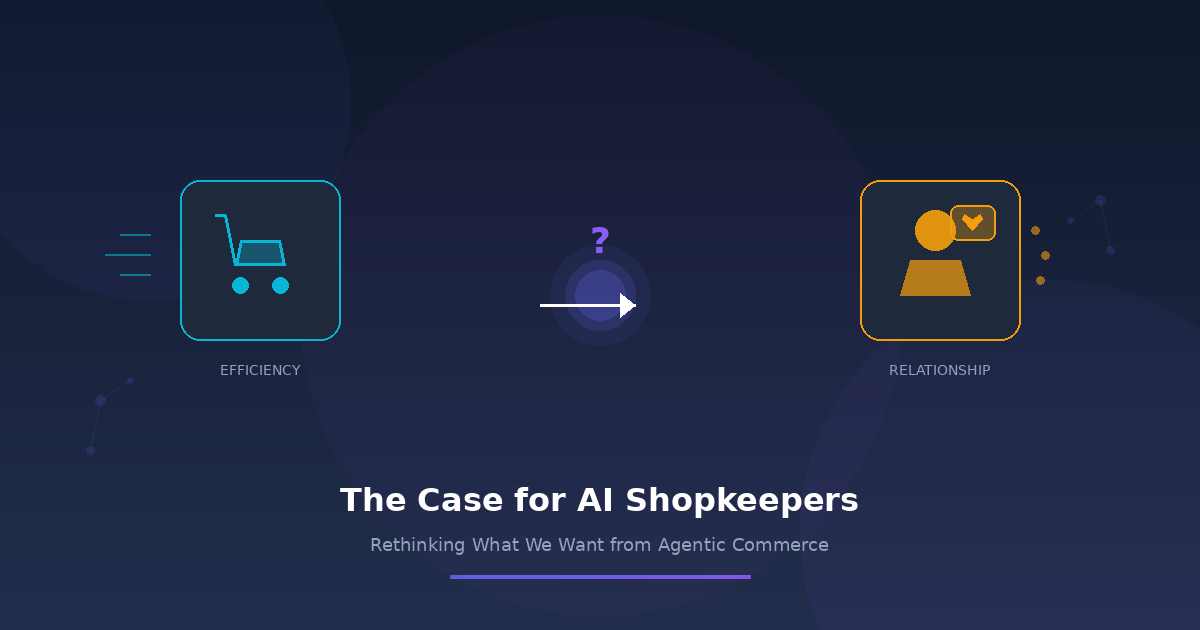
Everyone’s racing to build AI that shops for you. I think they’re solving the wrong problem.
Over the past few months, I’ve been watching the agentic commerce space explode. OpenAI partnered with Target. Amazon launched “Buy For Me.” Google is building price tracking into its AI. Startups like Perplexity and Daydream are positioning themselves as your personal shopping agents.
The pitch is compelling: AI that researches products, compares prices, and executes purchases on your behalf. No more endless scrolling. No more comparison shopping. Maximum efficiency.
But here’s what’s been nagging at me: efficiency isn’t why I enjoy shopping. And I don’t think I’m alone.
The Current Landscape: Two Camps, Same Assumption
Looking at what’s being built, I see two distinct approaches emerging.
First, there are the buyer’s agents—tools like ChatGPT’s shopping features, Perplexity’s product search, and startups like Daydream. These work across retailers, acting as your research assistant and sometimes your purchasing agent. They’re optimizing for finding the best deal, fastest.
Then there are the brand assistants—Amazon’s Rufus, Shopify’s sidekick tools, and various retail chatbots. These live within a single ecosystem, helping you navigate that specific store’s inventory. They’re optimizing for conversion within their walls.
Both camps share the same underlying assumption: shopping is a problem to be solved. A friction to be eliminated. An inefficiency to be optimized away.
I’m not sure that’s right.
What We Lost When Shopping Went Digital
Think about the best shopping experiences you’ve had. I’d bet most of them involved a person—a knowledgeable salesperson at a specialty store, a boutique owner who remembered your preferences, a sommelier who introduced you to something you never would have found on your own.
These weren’t efficient experiences. They were good experiences. There’s a difference.
The neighborhood bookstore owner who says “I know you loved that last novel—this just came in and it’s not what you’d usually pick, but trust me” is providing something that no recommendation algorithm has replicated. It’s not just personalization. It’s judgment, taste, and a relationship that develops over time.
E-commerce gave us infinite selection and lower prices. It took away the shopkeeper.
The Missing Model: AI as Shopkeeper
What if instead of building AI that eliminates the shopping experience, we built AI that enriches it?
I’ve been thinking about what an “AI shopkeeper” might look like—not a tool that shops for you, but one that shops with you. Something closer to that knowledgeable boutique owner than to a price-comparison engine.
This would be an AI with genuine expertise in its domain. Not just product specs pulled from a database, but the kind of knowledge that comes from deeply understanding a category—knowing why one running shoe works for overpronators and another doesn’t, or which wines from a specific region are actually worth the premium.
It would have memory and relationship. It would remember that you tried that coffee recommendation and found it too acidic, that you’re shopping for your sister who has different taste than you, that you’ve been slowly upgrading your home office over the past year.
And it would have opinions. Real ones. “Honestly, I wouldn’t recommend that for you—here’s why” is something a good shopkeeper says all the time. Current AI assistants are trained to be helpful to the point of being useless for actual decision-making.
Why This Might Matter Commercially
I’ll admit this might sound like nostalgia dressed up as strategy. But I think there’s a real business case here.
Discovery, not just search. The best retail experiences introduce you to things you didn’t know you wanted. That’s hard to do when AI is optimizing for “fastest path to purchase.” There’s value in serendipity, and current approaches are engineering it out of the system.
Trust and differentiation. If every retailer has the same AI assistant optimizing for the same metrics, where’s the differentiation? A shopkeeper with genuine expertise and personality could be a real competitive advantage—the reason you go to one store over another.
Higher-value purchases. For considered purchases—furniture, electronics, specialty goods—people often want guidance, not just information. They want someone to help them think through the decision. That’s worth paying for.
Retention through relationship. If an AI actually remembers me and gets better at serving me over time, that’s a switching cost. Not a manipulative one—a genuine one, like the reason I keep going back to my local coffee shop.
What Would This Actually Require?
Building this is harder than building another shopping agent. A few things seem necessary:
Personality and point of view. This is the hardest part. Current LLMs are trained to be neutral and helpful. A good shopkeeper has taste, preferences, even biases. Creating AI with genuine (and appropriate) opinions is a design challenge we haven’t solved.
Real memory. Not just “here’s your order history” but contextual memory of conversations, preferences that emerged over time, the relationship itself. This is technically possible now but rarely implemented well.
Honesty over conversion. This might be the biggest barrier. A shopkeeper who’s obviously trying to maximize your cart value isn’t a shopkeeper—it’s a salesperson. The AI would need permission to say “don’t buy that” or “you don’t need this.”
A different interface paradigm. Chat might not be the right model. The best shopping experiences blend conversation with browsing, touching, comparing. What’s the digital equivalent?
Domain expertise that’s earned. Generic AI trained on product descriptions isn’t enough. This would need deep, specialized knowledge that feels authoritative—probably requiring significant investment in training and curation.
The Honest Tension
I’ll be honest about the tension in this idea: I’m not sure AI can create a genuine relationship. What makes the neighborhood shopkeeper valuable isn’t just that they remember you—it’s that they’re a person, with their own life and experiences, who has chosen to invest in knowing you.
Can AI replicate that? Or would an “AI shopkeeper” always be a simulation of relationship rather than the real thing?
I don’t have a clean answer. But I suspect there’s a middle ground—AI that’s honest about what it is while still providing something more human than what we have now. Better a friendly, knowledgeable AI than another faceless recommendation engine.
Where This Leaves Me
I’m not building this (at least not yet). But I’ve been thinking about it because it represents a different philosophy of what AI in commerce could be.
The current race is toward AI that makes shopping invisible—purchase decisions made by agents on your behalf, optimized for efficiency and price. That has its place.
But I think there’s room for AI that makes shopping more human, not less. AI that brings back the expertise, the relationship, and yes, even the pleasant inefficiency of a great retail experience.
The shopkeeper didn’t disappear because people didn’t value them. They disappeared because the economics of e-commerce couldn’t support them. AI might change that equation.
That’s an opportunity worth exploring.